
Of all the foods that have passed through American kitchens in the last hundred years, none has been written about less and remembered more than the church potluck casserole.
Food writers have spent decades celebrating Julia Child’s boeuf bourguignon, the rise of California cuisine, the arrival of sriracha on every table in the country. But the dish that actually fed most Americans through the middle decades of the twentieth century?
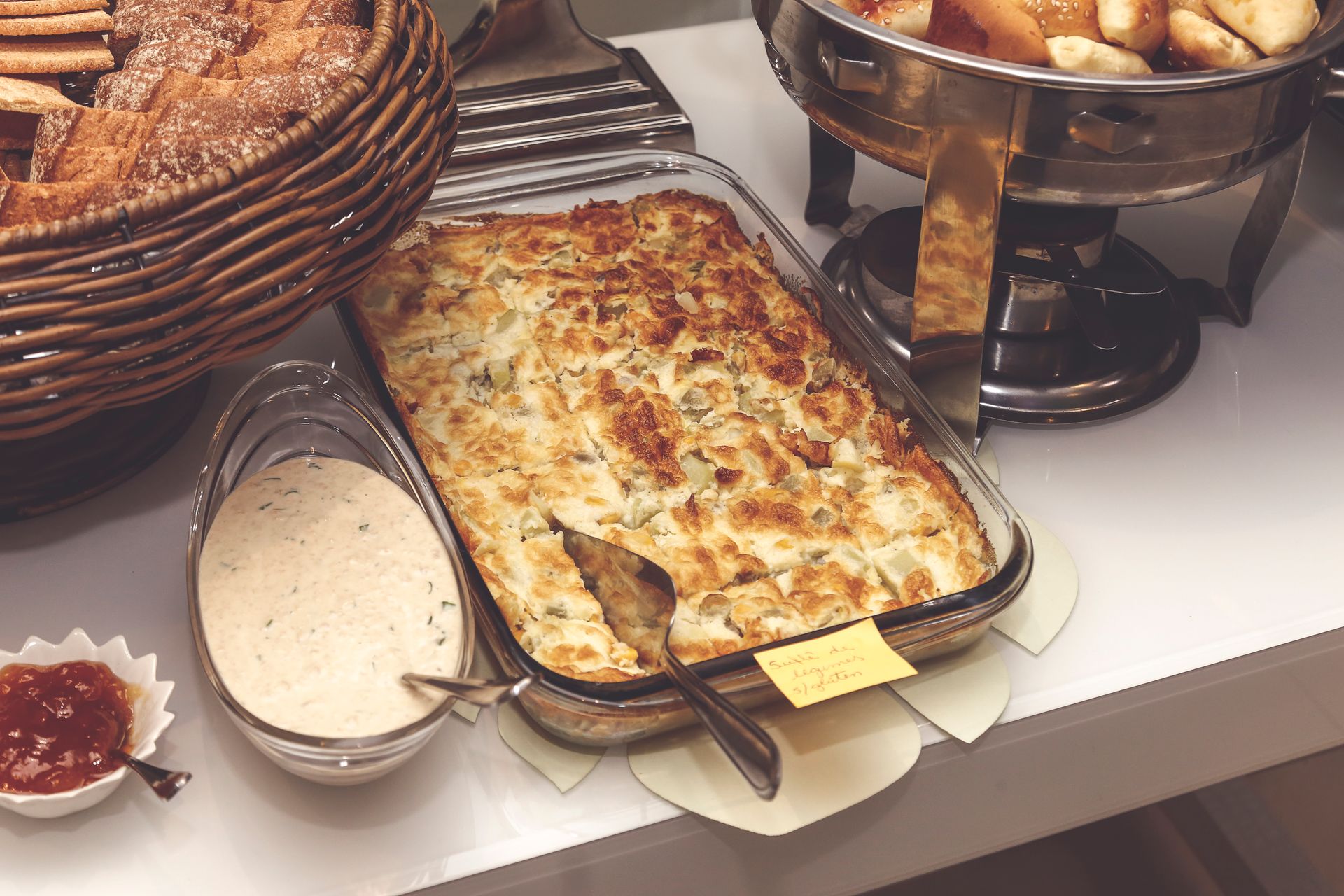
It came in a Pyrex pan, it was wrapped in dish towels to stay warm on the drive over, and nobody wrote it down the same way twice.
That is not an accident. It is, in fact, the whole point.
Table of Contents
What the Recipe Card Never Captured


The church potluck casserole was never really about the recipe. It was about the occasion. A covered dish supper after the Sunday service. A Wednesday night fellowship meal.
A reception in the church hall following a funeral, or a baby shower, or a homecoming for a family that had been through something hard. The casserole showed up at all of it, and it showed up because it was the one dish almost anyone could make, transport, and multiply without much fuss.
What went into it varied enormously by region, by decade, by what was in the pantry. In the Midwest through the 1950s and 1960s, cream of mushroom soup was a near-universal binder. Campbell’s had made it both affordable and trusted, and home cooks found it did the work of a sauce without requiring one. Green beans, tuna, chicken, ground beef, egg noodles:
The protein and vegetable changed, but the creamy center stayed. In the South, sweet potato casseroles appeared alongside rice dishes and corn-based recipes that reflected a different set of pantry staples and a different set of hands that had shaped Southern cooking over generations. In church communities across the Northeast, covered dishes often ran toward baked beans, macaroni, and scalloped potatoes, things that could sit on a warming tray for two hours and still taste exactly right.
None of these were considered fine food. That was never the negotiation.
The Thing Nobody Counted
Here is what food historians tend to overlook when they trace the arc of American home cooking: the potluck casserole was one of the primary mechanisms by which recipes actually spread across communities before the internet, before the Food Network, before celebrity chefs had names that ordinary people knew.
A woman brought a dish to a potluck. Someone asked for the recipe. She wrote it on a scrap of paper, or she typed it on an index card, or she submitted it to the church cookbook that the ladies’ auxiliary was putting together as a fundraiser.
Those church cookbooks, spiral-bound, printed locally, sold for a dollar or two, were found in countless American kitchens by the middle of the century. They were not the Betty Crocker Picture Cookbook. They did not have glossy photographs or celebrity endorsements. But they had something better: they had the names of real people in the community attached to every single recipe.
“Mildred’s Hot Chicken Casserole.” “Ruth’s Company Green Bean Bake.” “Dorothy’s Macaroni and Cheese for a Crowd.”
Those names mattered. They still do, to anyone who grew up with one of those cookbooks on a kitchen shelf.
And here is the strange part. The casserole that showed up at the potluck was rarely the same as the written recipe. Every cook adjusted. More cheese. Less salt. A different brand of soup. A handful of crushed crackers on top instead of the breadcrumbs the recipe specified. The dish was a framework, not a formula, and the community understood this implicitly. Nobody complained that yours tasted different from the last time. That was part of what made it yours.
Why It Mattered More Than Food

There is a phrase that food sociologists use, “eating together as social glue”, that sounds academic and slightly bloodless when you read it, but that describes something real. The potluck meal operated on a principle that most modern food culture has quietly abandoned: that the act of cooking something and carrying it to a shared table was itself a form of participation. You did not just attend the fellowship supper. You contributed to it. Your casserole was your presence, made edible.
For women in midcentury America, this was particularly significant. The church potluck was one of the few spaces where cooking, work that happened daily and mostly invisibly in the home, was publicly recognized and openly evaluated. Your dish was tasted by the whole community.
It was praised or quietly left mostly untouched, and you noticed either way. There was a hierarchy in those church halls, and it ran through the casserole dishes as clearly as anywhere. The woman whose chicken tetrazzini was always finished first knew exactly what that meant.
This is not nostalgia talking. It is an honest accounting of what those meals were doing, underneath the surface of fellowship and faith.
What Happened to It

The church potluck casserole did not disappear. But it did change, and so did its context. Attendance at organized religious communities in the United States declined steadily through the final decades of the twentieth century. The Wednesday night fellowship meal became less common.
The ladies’ auxiliary that organized the covered dish supper aged out of the work without a younger generation to take it over. And American food culture, which had spent decades being told it was becoming more sophisticated, started to look at the casserole with a kind of embarrassment it had not felt before.
Convenience food took some of the blame, unfairly. The cream-of-mushroom-soup casserole was already convenience food; that was always part of its appeal. What actually changed was the social architecture around it. The occasion that justified making and carrying a covered dish to a shared table became rarer. Without the occasion, the dish lost its meaning.
A tuna noodle casserole made for a Tuesday night dinner at home is a perfectly fine dinner. But it is not the same thing at all as that same dish carried across town in a warm towel, set out on a folding table in a church hall, and eaten alongside forty other people who all brought something of their own.
The container was the same. Everything else was different.
What Stayed

What is striking, now, is how many people still know these recipes by heart, or think they do, until they try to write them down and realize the measurements were never precise. A generation of American cooks absorbed these dishes through watching and tasting, not through reading. The casserole lived in muscle memory: the way you knew the topping was ready by the smell, not the timer. The way you could tell by the sound of the bubbling whether it needed ten more minutes.
Those church cookbooks, the ones with the spiral bindings and the photocopied or mimeographed pages, are now treated as historical artifacts by food historians and estate sale regulars alike. Some sell for more than the recipes inside them would ever suggest. What people are buying, in part, is the list of names: Mildred, Ruth, Dorothy, and all the others who fed their communities one covered dish at a time, and never once thought of themselves as doing anything worth writing about.
They were wrong about that.
Sources
Background on the history and social function of communal covered-dish meals in American culture; context on the tradition of church fellowship meals and their role in American religious and community life
This article was created with AI assistance and reviewed for clarity and accuracy.