
Of all the searches typed into Google on a Tuesday evening, few are more honest than “30-minute dinner.” No one is browsing. No one is curious. Someone is standing in a kitchen at 6:15 p.m., kids are somewhere in the background, and dinner needs to happen. The search is a small cry for help, and the gap between what food sites serve up in response and what families actually cook from is wider than most publishers want to admit.
The disconnect matters because it shapes what millions of households eat every week. Food media has spent years optimizing for clicks, not kitchens. The result is a strange inflation in weeknight cooking recipes that technically meet a 30-minute label but require julienned vegetables, three specialty ingredients, and a mandoline. Not impossible. Just not Tuesday.
Table of Contents
What “30 Minutes” Actually Means in a Real Kitchen

There are two versions of a 30-minute dinner. The food-site version starts the clock after you’ve already prepped, measured, and laid out your mise en place like a culinary student on an exam. The kitchen version starts when a parent walks through the door. That distinction, prep time versus hands-on time versus total elapsed time, is where the math quietly falls apart on most published recipes.

Harold McGee spent years documenting the gap between recipe instruction and kitchen reality in home cooking. The fundamental finding isn’t controversial among food writers: recipe developers test in controlled conditions. Home cooks do not operate in controlled conditions. They operate in the actual world, where the onion takes longer to soften because the burner runs low, or the chicken thighs came straight from a cold fridge.
The meals that actually work on a Tuesday are built around a different logic. Not “fewer steps”, fewer decisions. Sheet-pan dinners dominate weeknight cooking not because they’re faster in absolute minutes, but because they collapse the decision tree. One pan. One temperature. One cleanup. The cognitive load is as important as the clock.
The Proteins That Actually Win

Ground beef is the most underrated weeknight protein in America. It defrosts fast, browns in under ten minutes, and accepts almost any flavor direction. Mexican, Italian, Asian-inflected, whatever the pantry holds. Yet food media consistently elevates chicken breast as the weeknight hero, despite the fact that chicken breast is genuinely harder to cook well under time pressure. It dries out above 165°F, has a narrower window between undercooked and overcooked than thighs or ground meat, and rewards neither high heat nor impatience.
Ground beef forgives impatience. That’s a feature, not a limitation.
Rotisserie chicken changed weeknight cooking more quietly than any appliance trend of the last two decades. Grocery stores began stocking them reliably in the 1990s, and they solved a problem that no recipe can solve: the protein is already cooked. Families who buy one on the way home aren’t cheating. They’re doing exactly what professional cooks do: they’re controlling variables. Strip it, warm a tortilla, add whatever’s in the vegetable drawer. That’s not a shortcut. That’s a system.
The Pantry Architecture Nobody Talks About

Here’s the strange part: the families who cook fast on weeknights aren’t necessarily faster cooks. They’ve built what restaurant kitchens call mise en place at the pantry level, a standing inventory of components that collapse dinner time into assembly rather than construction.
Canned tomatoes. A jar of tahini or miso. Good olive oil. Dried pasta in three shapes. A rotating stock of whatever aromatics are cheapest that week. None of this is glamorous. None of it photographs well. But it’s the actual infrastructure behind most real 30-minute meals, and food media almost never discusses it because it’s not a recipe. It’s a habit.
The Maillard reaction, the browning that creates flavor in seared meat, toasted bread, caramelized onions, is the most important process in weeknight cooking that most home cooks have never heard named. Understanding it changes behavior: you stop crowding the pan, you let the protein sit without moving it, you stop lifting the lid. The 30-minute dinner gets faster not because you move faster, but because you stop interrupting the chemistry.
The One-Pot Reality
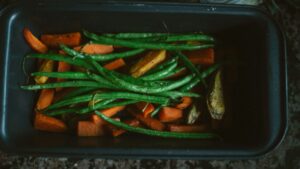
One-pot recipes dominate actual weeknight cooking for a reason that has nothing to do with flavor. It’s the dishes. A family that cooked dinner in one pot is a family that doesn’t spend forty minutes at the sink afterward. The total time cost of a meal includes cleanup, and any recipe that ignores that arithmetic is optimizing for the wrong variable.
Braises that take three hours on a Sunday become thirty-minute dinners on a Tuesday if you use a Dutch oven and a pressure cooker setting. Beans cooked from dry over a weekend become three different Tuesday dinners: tacos, soup, a quick grain bowl. The weeknight dinner that works is rarely a single recipe. It’s usually the end of a chain that started on Saturday.
Food sites rarely frame it that way because a chain of preparation doesn’t sell a single recipe. But it’s how people who cook efficiently actually think.
What the Search Data Implies

When tens of millions of people search for a 30-minute dinner on a Tuesday, they’re not searching for a new recipe. They’re searching for permission. Permission to use the rotisserie chicken. Permission to make eggs for dinner. Permission to throw together pasta with whatever’s in the pantry and call it a meal.
The recipes that get clicked most in weeknight searches skew toward familiar proteins, short ingredient lists, and techniques that don’t require explanation. Not because home cooks are unadventurous, but because Tuesday at 6 p.m. is not the moment for adventure. The search isn’t “surprise me.” The search is “help me.”
The gap between what food sites publish and what families actually cook isn’t a failure of ambition on the reader’s part. It’s a misread of the brief on the publisher’s part. The best 30-minute dinner isn’t the most impressive one. It’s the one that actually happens.
Most of the meals that feed American families on weeknights will never appear in a food magazine. They don’t have names. They’re not searchable. They’re whatever was in the fridge, applied with enough skill and enough confidence to land on the table before 7 p.m. That’s the real weeknight dinner, and the fact that it keeps working, night after night, without a recipe, is the part nobody covers.
Sources
Background on kitchen science writing and culinary research methodology</li>
Overview of the browning chemistry referenced in the cooking technique section
Background on the rise of grocery-store rotisserie chicken in American home cooking
This article was created with AI assistance and reviewed for clarity and accuracy.