

At 140°F, yeast dies. Not slows down. Not struggles. Dies, completely and without recovery. And yet the most common piece of bread-baking advice still floating around home kitchens is “use warm water,” a phrase so vague it has quietly ruined more loaves than any other four words in American cooking.
Temperature is the hidden variable in baking. Most recipes treat it as a footnote. Preheat to 375°F, the instructions say, and somewhere in there assume you understand what the oven, the dough, the butter, and the eggs are actually doing at each stage. Most of us don’t.
We were taught to bake by intuition, by eye, by the smell of something almost burning. That’s charming. It’s also why the same recipe produces inconsistent results every time.
There are six moments in the baking process where temperature stops being a guideline and starts being a mechanism. Get them right,t and the chemistry works. Miss them by ten degrees in some cases, by thirty in others, and you’re not adjusting a recipe. You’re fighting physics.
Table of Contents
Where Yeast Actually Lives and Dies


The window for active dry yeast is narrower than most bakers realize. Water below 70°F won’t kill it, but it won’t reliably wake it either. The yeast sits there, sluggish, generating just enough gas to make you think the dough is rising before it stalls completely.
Water above 110°F starts damaging the cells. Past 140°F, there’s nothing left to save. The target range for activating active dry yeast is 100°F to 110°F, warm enough to feel almost uncomfortably hot on the inside of your wrist, which is the old professional kitchen test before instant-read thermometers became standard equipment.
Instant-read thermometers cost less than twelve dollars at most kitchen supply stores. There is no reason to guess at water temperature in 2025. None. The wrist test is folklore. The thermometer is fact.
The Butter Problem Nobody Talks About

Creaming butter and sugar is described in almost every cookie and cake recipe as a simple step. Beat until light and fluffy. What those instructions don’t say is that butter temperature determines whether the creaming process works at all. Cold butter, below 60°F, won’t incorporate air.
It just chunks and batters against the bowl. Butter above 72°F has lost its structural rigidity and will collapse into a greasy slick instead of a foam.
The ideal temperature for creaming butter is between 65°F and 68°F. At that range, the fat is pliable enough to trap air bubbles with each pass of the paddle, and firm enough to hold them.
Those bubbles are what makes a butter cake rise before the baking powder even activates. Pull cold butter from the refrigerator and try to cream it immediately, ly and the cake will be dense regardless of how long you run the mixer.
The fix is simple and takes planning: butter needs about 45 minutes on the counter to reach the right temperature, depending on kitchen conditions. Set a thermometer in it. Stop guessing.
The Gluten Window

Bread dough has a temperature range where gluten development happens efficiently. Bakers call it the desired dough temperature, or DDT, and professional bread bakers calculate it precisely before mixing. The target is typically between 75°F and 78°F for most lean bread doughs.
Below that range, fermentation slows, and gluten develops sluggishly. Above it, fermentation accelerates too fast, and the dough can overproof before the structure sets.
Here’s the part most home baking books skip entirely: the friction from mixing generates heat. A stand mixer running for ten minutes raises dough temperature measurably, sometimes by 5°F or more. That matters. Professional bakers compensate by adjusting water temperature before mixing.
Home bakers don’t, which is why doughs made in a warm kitchen in July behave differently than doughs made in January even from the same recipe.
An instant-read thermometer stuck into the center of the dough before the first rise takes three seconds. It will tell you more about how the next two hours will go than anything else.
What the Oven Dial Doesn’t Tell You

Most residential ovens run significantly off from their set temperature. Not by one or two degrees, but by 25°F to 50°F in either direction in many cases. Some cycle dramatically between high and low as the thermostat kicks on and off. A baked good that sits in an oven that swings between 330°F and 390°F when you’ve set it to 350°F is being cooked by a different recipe than the one you read.
An oven thermometer costs less than a bag of flour and hangs on the rack permanently. Every serious home baker owns one. Most casual bakers don’t, and then wonder why the same cake recipe fails in their kitchen when it worked at their sister’s house.
The second oven-temperature issue is more specific: steam. Bread baking in the first ten minutes of the oven requires a moist environment to allow the crust to expand properly before it sets. Professional deck ovens inject steam. Home bakers mimic this by adding a pan of hot water to the bottom of the oven or by baking inside a covered Dutch oven, which traps steam from the dough itself.
The temperature at which that crust springs open and sets, roughly the first ten to fifteen minutes at high heat, often 450°F to 500°F for lean breads, determines the final volume of the loaf. Miss that window and no amount of baking time recovers it.
The Number That Ends the Guessing
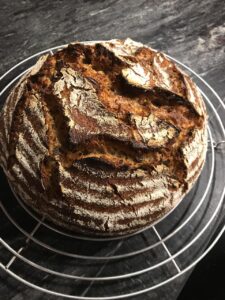
There is one temperature that home bakers underuse more than any other, and it is the most straightforward of all of them. The internal temperature of a finished loaf of bread. Fully baked sandwich bread reaches an internal temperature of approximately 190°F to 200°F.
Lean artisan breads, sourdoughs, baguettes, anything with a hard crust, typically need to reach 205°F to 210°F. Pull bread from the oven before it hits those numbers and the crumb hasn’t fully set, even if the crust looks done. It will gum and collapse when sliced.
Tapping the bottom of a loaf and listening for a hollow sound is a real technique. It works, more or less. But it works the way pressing a steak with your finger works, with practice and calibration and the accumulated experience of doing it wrong a few dozen times first. A thermometer works the first time.
The Last Number: Resting Temperature

This one is less about baking and more about the physics of starch. A freshly baked loaf of bread is still cooking when it comes out of the oven. The internal starches are in a semi-gelatinized state, and the moisture is redistributing from the crumb toward the crust.
Slicing into bread before it has cooled to around 90°F to 100°F compresses the crumb and releases steam that hasn’t finished its work. The texture suffers. The loaf that looked perfect coming out of the oven turns gummy and dense under the knife.
The resting time varies by loaf size; a small roll needs fifteen minutes; a large sourdough boule may need an hour or more. The thermometer tells you when it’s done waiting, too.
None of this is complicated. Six numbers, two pieces of equipment, and a willingness to check rather than guess. The recipes haven’t changed. The physics never does.
Source:
This article was created with AI assistance and reviewed for clarity and accuracy.