

There is a moment every home cook knows. The sandwich is golden on both sides, the bread is exactly right, and then you cut into it, and the cheese is still sitting there in a cold, rubbery slab, barely warmed through. You did everything else right. The cheese let you down.
This happens more often than it should, and the reason is almost always the same: the wrong cheese for the job. Not bad cheese, necessarily. Just cheese that was never going to behave the way you needed it to. Cheese science is real, and it matters, and the dairy aisle at your grocery store gives you almost no help sorting it out.
Here’s where it gets interesting, though. Once you understand what makes a cheese melt well or refuse to, grocery shopping gets a lot more useful. You stop grabbing the first bag of shredded blend you see and start thinking about what you’re actually cooking.
Table of Contents
Why Some Cheeses Melt, and Others Don’t


The short answer is moisture and fat. Cheeses with higher moisture content, think young, soft, or semi-soft varieties, tend to melt smoothly because the water in them turns to steam as they heat, loosening the protein structure. Cheeses with very low moisture (aged Parmesan, for instance, or a hard aged cheddar) have tightly packed proteins that resist flowing. They’ll soften and eventually melt, but they take more heat,t and they can turn grainy or oily if you push them too far.
Fat plays a role too. Full-fat cheeses melt more smoothly than reduced-fat versions, which is why that “light” shredded mozzarella never quite behaves the way the full-fat version does. The fat coats the proteins and keeps them from seizing up. Pull out the fat,t and the proteins tighten. The result is a stringy, uneven melt that doesn’t pool or flow the way you pictured.
Acid content matters as well. Cheeses made with more acid, like fresh chèvre, paneer, and ricotta, have proteins that are deliberately set by that acid. They’ll soften under heat, but they won’t melt into a puddle. That’s actually useful to know when you’re cooking, because it means they hold their shape in a hot oven without turning to liquid.
The Cheeses Worth Knowing at Your Grocery Store

Young mozzarella is the cheese most people already trust for melting, and they’re right to. It’s high in moisture, mild in flavor, and turns beautifully stretchy under heat. The fresh-packed kind, the soft ball sitting in liquid, melts faster and wetter than the low-moisture block version. For pizza, the block. For a Caprese that goes under the broiler for a moment, the fresh. They’re not interchangeable, and knowing which is which matters.
Fontina is the cheese that home cooks consistently overlook, and it deserves better. It melts almost as smoothly as mozzarella but has an earthy, slightly nutty flavor that makes everything taste more intentional. Stir it into a pan sauce, layer it in a gratin, use it anywhere you’d use Gruyère but want something a little less expensive. Most grocery stores carry it near the specialty cheese section.
Gruyère itself is worth the extra cost for certain dishes. It melts with a richness that’s hard to match, and it’s what makes a proper French onion soup or a croque-monsieur taste as it came from somewhere with tablecloths. The flavor is complex enough that you need less of it, which partly offsets the price.
American cheese, the real processed kind, not the individually wrapped slices, melts more reliably than almost anything else in the case. This is not an accident. Processed cheese was engineered specifically to melt smoothly and hold an emulsion without breaking. If you’re making a stovetop mac and cheese and you want a sauce that stays creamy and glossy rather than turning grainy, a slice or two of American stirred in at the end is the professional kitchen trick you’ve been missing. It’s not glamorous. It works.
Colby and Colby Jack are underrated workhorses. They melt cleanly, they’re mild enough not to compete with other flavors, and they cost less than most of the specialty options. For quesadillas, breakfast burritos, or anything you’re making on a weeknight without much ceremony, Colby is reliable in a way that matters when you’re cooking for a family.
Provolone sits between mozzarella and a sharper cheddar in flavor, and it melts well enough to use on sandwiches, baked pasta, and anything going under a broiler. The aged version (The aged version (piccante versus dolce) has more bite and slightly less cooperative melt, so for cooking purposes the dolce (mild) variety is generally the better choice.) has more bite and slightly less cooperative melt, so for cooking purposes, look for the mild version.
Pepper Jack melts almost as easily as Colby Jack, with the addition of jalapeño and sometimes other peppers worked into the cheese. For enchiladas, nachos, or a burger that needs heat built in, it’s a practical choice and one of the more flavorful options in the standard grocery case.
Sharp cheddar is where things get complicated. A young or medium cheddar melts fairly well. A very sharp, aged cheddar, particularly a good-quality block rather than pre-shredded, gets more finicky under direct heat and can separate into greasy pools if you push it too hard. The trick is low heat and patience, or using it in a sauce where you can control the temperature carefully. Pre-shredded sharp cheddar is coated with cellulose or potato starch to keep it from clumping, which also slightly inhibits melting. Shredding your own from a block makes a real difference.
A Note on Pre-Shredded vs. Block
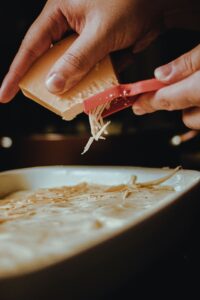
Pre-shredded cheese is convenient, and there’s no reason to feel guilty about buying it. But for any dish where melting quality matters- a gratin, a stovetop sauce, a proper grilled cheese- shredding your own from a block will give you a smoother, more even result. The anti-caking coating on pre-shredded cheese is real, and it affects the melt. Not dramatically, but enough to notice.
If you’re melting cheese into a hot liquid (a sauce, a soup, a fondue), grating the cheese finely helps enormously. The smaller the pieces, the faster and more evenly they incorporate. And always add cheese to a sauce off the heat or at the lowest simmer; high heat makes proteins tighten and fat separate, which is how you get a grainy sauce instead of a smooth one.
What to Reach For, by Dish

For grilled cheese: young mozzarella or a mix of provolone and Colby Jack. Or, and this is the trick most diners use, one slice of American underneath and something more flavorful on top.
For stovetop mac and cheese: sharp cheddar shredded from a block, plus one or two slices of American to keep the sauce from breaking.
For gratins and casseroles: Gruyère or fontina, alone or combined. Both melt slowly and evenly in the oven without turning rubbery.
For pizza: low-moisture mozzarella block, shredded yourself. It browns better and has the right stretch.
For quesadillas and nachos: Colby Jack or Pepper Jack. Both melt quickly, which matters when you’re working fast.
The dairy aisle looks the same every time you walk through it. But once you know what you’re looking at, it reads differently. The right cheese for the right dish isn’t a secret; it’s just information most packaging doesn’t bother to give you.
Sources
Science background on moisture, fat, and protein behavior in melting cheese
Background on emulsification, engineering of processed cheese for melting
Practical category-by-category breakdown of grocery store melting cheeses
</ul>
This article was created with AI assistance and reviewed for clarity and accuracy.