

There was a version of this dish that lived on the back of the stove every Sunday in a lot of American kitchens. A heavy pot, a whole chicken, broth going cloudy and golden by noon. And then the dumplings dropped in by spoonfuls, the lid going on, the whole thing left to do its work. If you grew up with that smell, you know exactly what we’re talking about.
Chicken and dumplings is one of those recipes where the method matters more than the ingredient list. The broth can be perfect, the chicken tender and falling apart, but if the dumplings come out dense and gummy, the whole dish feels like a disappointment. And that’s the part most recipes skip over: not what goes in the dumplings, but what happens to them once they hit the liquid.
So here’s the thing most people don’t know: dumplings don’t bake. They steam. The moment you understand that, everything else about the technique makes sense.
Table of Contents
What’s Actually Happening in That Pot
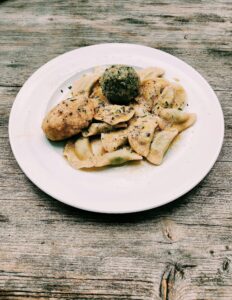

When you drop a dumpling into simmering broth, the bottom half is in contact with liquid and the top half is in contact with steam trapped under the lid. Both forces are cooking the dumpling at the same time. The steam is what makes the inside light and airy. The broth is what gives the outside its tender, slightly slick skin. If you lift the lid while this is happening, the steam escapes and the whole process collapses. The dumpling finishes cooking in wet heat instead of steam, and you end up with something dense in the middle and slightly waterlogged on the outside.
This is why every grandmother who made this dish told you to leave the lid alone. She may not have known the physics of it. But she knew the result.
The lid stays on for the full cooking time, usually 15 to 18 minutes once the dumplings go in. Not a peek. Not a quick lift to check. You’ll know they’re done when they’ve puffed up and a toothpick or thin skewer comes out clean from the center of the largest one.
The Dough Itself: Where Most Recipes Go Wrong

The classic dumpling dough is close to a drop biscuit dough. Flour, baking powder, salt, fat, and a liquid, usually milk or buttermilk. Some old recipes call for shortening; others use butter. Both work, though butter gives a slightly richer flavor and shortening gives a more neutral, pillowy result. What they share is the same logic: cold fat, worked in quickly, not overhandled.
Overmixing is the single most common mistake. Once the liquid goes in, you stir only until the dough just comes together. There will be lumps. That’s right. Lumps mean the gluten hasn’t overdeveloped, and underdeveloped gluten means a tender dumpling instead of a chewy one. A dozen stirs is usually enough. If the dough looks smooth and uniform, you’ve gone too far.
The other thing that matters is the simmer. The broth should be at a gentle, steady simmer when the dumplings go in, not a rolling boil. A hard boil will knock the dumplings around, break them apart before they set, and cook the outside too fast while the inside stays raw. Medium-low heat, a lid that fits well, and patience. That’s the method.
The Broth Is Half the Recipe

Here’s where the dish can go from good to the kind of thing people ask you to make again. The broth that dumplings cook in should be deeply flavored, because the dumplings will absorb some of it during cooking. A thin, lightly seasoned broth produces thin, lightly flavored dumplings. A rich, seasoned broth produces something else entirely.
The most reliable path is to poach a whole chicken, or bone-in, skin-on thighs and drumsticks, in water with an onion, a few celery stalks, a carrot, salt, and a bay leaf. Low and slow, until the meat is falling off the bone. Pull the chicken out, shred the meat, and discard the vegetables. What’s left in the pot is your cooking liquid. Skim it, taste it, adjust the salt. That’s your base.
Some cooks stir a little flour into butter before adding the broth back in, creating a very light roux that thickens the liquid just enough to give it body. Others prefer the broth thinner and let the dumplings do the thickening on their own as they cook. Both are correct. It depends on whether you want something closer to a stew or something closer to a soup.
The chicken goes back in once the broth is ready, shredded, off the bone, scattered through the pot. Then you bring it to that gentle simmer and drop the dumplings in.
Drop vs. Rolled: A Real Difference

Two schools. That’s it. American chicken and dumplings splits pretty cleanly along regional lines, and families treat the divide like a matter of principle. The Southern tradition runs toward flat, rolled dumplings, thin strips of dough that cook down silky and dense, almost like a wide noodle.
The Northern and Midwestern version goes the other direction: drop dumplings, dropped by the spoonful, puffed up and cloud-like. Neither is wrong. But they produce genuinely different results, and if you grew up with one, the other can look like a mistake. The rolled kind seems undercooked to a drop-dumpling person. The drop kind looks flat-out wrong to someone raised on strips.
The technique described here is for drop dumplings, because that’s the version where the steam-lid method matters most. Rolled dumplings cook differently; they’re thin enough to cook through in the liquid itself, and the lid isn’t as critical. But if that’s the version you remember, the same broth recipe applies. Roll the dough to about a quarter inch, cut it into strips or squares, and drop them straight into the simmering broth. They’ll thicken the liquid as they cook.
A Few Things Worth Knowing Before You Start
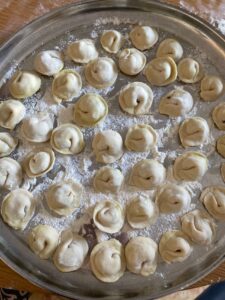
Cold ingredients matter for drop dumplings in the same way they matter for biscuits. Cold fat, cold milk, cold hands if you can manage it. The fat should be cut into the flour until the mixture looks like coarse crumbs before the liquid goes in. Room-temperature butter will cream into the flour instead of cutting through it, and you’ll lose the layered structure that makes the dumpling light.
Buttermilk, if you have it, adds a gentle tang and reacts with the baking powder to give the dumplings a little more lift. If you don’t have it, a splash of white vinegar or lemon juice stirred into regular milk and left for five minutes will do the same job.
Season the dough. Not heavily, but season it. A little salt, a pinch of black pepper, maybe some fresh thyme if you want an herbed version. The dumplings are going to pull flavor from the broth as they cook, but they need their own base underneath that, or they’ll taste like nothing.
And serve it now. Not in an hour. Chicken and dumplings does not hold. The dumplings keep drinking up liquid as they sit, and the texture goes wrong fast. This is a pot you bring to the table hot and serve straight out of. It rewards the patience you put in earlier. That’s the deal it makes with you.
This article was created with AI assistance and reviewed for clarity and accuracy.