

Of all the baking failures a home cook can pull from the oven, a sunken cake is the one that stings the most. The top looks fine. The edges are golden. And then there’s that crater in the center a soft, collapsed valley where a proud dome was supposed to be. Most bakers blame the oven. The oven is rarely the problem.
Cake structure is an engineering problem, not a luck problem. Every sunken center has a cause, and almost every cause is traceable to one of five moments in the process: how you measured, how you mixed, how you handled the leavening, when you opened the oven, or how quickly you moved the pan. Understanding which moment failed tells you exactly what to fix.
Table of Contents
The Leavening Problem: Too Much of a Good Thing

Baking powder and baking soda do one job: they release carbon dioxide gas into the batter, which expands under heat and pushes the cake upward. The problem is that more leavening does not mean more rise. It means a bigger, faster rise, followed by a structural collapse before the proteins in the eggs and flour have time to set.

When a cake rises fast and sinks in the middle, excess leavening is the first thing to check. A level teaspoon is a level teaspoon. Heaping it, even slightly, changes the ratio. And leavening that has been sitting in the cabinet past its prime will behave unpredictably, sometimes over-reacting, sometimes doing almost nothing. The standard test: drop a teaspoon of baking powder into hot water. If it bubbles vigorously, it’s active. If it just sits there, replace it.
Old leavening is one of those kitchen problems nobody talks about until someone’s cake collapses at a holiday dinner. Worth checking now.
The Flour Measurement Problem
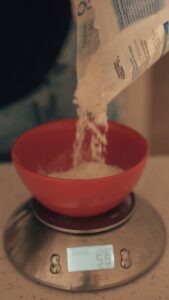
Most home bakers measure flour by scooping the measuring cup directly into the bag. This compacts the flour, and a compacted cup of all-purpose flour can hold significantly more flour than a properly spooned-and-leveled cup. Too much flour and the batter becomes dense. Not enough liquid movement between gluten strands. The center, which is always the last part of a cake to set, can’t rise and hold.
The fix is simple and permanent: spoon flour into the measuring cup with a separate spoon, then level it with a straight edge. Or use a kitchen scale, which removes the guesswork entirely. Once you bake by weight, measuring cups for flour start to feel like a relic.
The Mixing Problem. Overdoing It After the Flour Goes In

Here’s where a lot of recipes go wrong, and where a lot of bakers go wrong following them: overmixing after the flour is added. Once flour hits wet ingredients, gluten begins to develop. A little gluten gives a cake structure. Too much makes it tough, dense, and prone to sinking because the batter can’t expand properly in the oven’s heat.
The standard guidance, mix until just combined, is correct but underexplained. “Just combined” means exactly that: stop when the last streak of flour disappears. Not thirty seconds after. Not when the batter looks perfectly smooth. Lumps are fine. Lumps bake out. Overmixed batter does not recover.
This is especially true for butter-based cakes, where creaming butter and sugar correctly is critical. Under-creamed butter won’t hold the air pockets that give a cake its lift. Over-creamed butter breaks down those same pockets. The target is pale, fluffy, and slightly increased in volume, about three to four minutes with a stand mixer on medium.
The Oven Problem, and Why the Door Matters

The oven is not the main villain in a sunken cake, but it plays a role. An oven that runs hot will set the outside of a cake quickly while the center is still liquid batter. When the outer crust sets prematurely, it can’t expand, so the center, still trying to rise, has nowhere to go except down.
An oven thermometer is a $10 investment that changes baking permanently. Most ovens run anywhere from 25 to 50 degrees off their dial setting. If the dial says 350°F and the oven runs at 375°F, the cake bakes at the wrong temperature every single time.
The door is a separate issue. Opening the oven in the first two-thirds of the bake drops the interior temperature sharply. At that stage, the cake’s protein and starch structure is still forming, fragile enough that a sudden temperature drop can cause the center to deflate. Leave the door closed until the cake is within five minutes of the listed bake time, then check.
The Pan and Batter Volume Problem
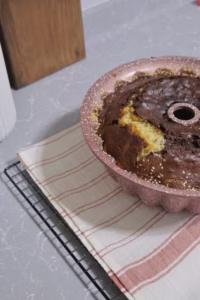
A pan that’s too small forces too much batter into too little space. The cake rises above the rim, then collapses inward because the structure can’t support the height. A pan that’s too large spreads the batter thin and bakes unevenly, creating a different kind of structural failure.
Standard 9-inch round pans hold about five to six cups of batter. If a recipe calls for a 9-inch pan and you’re using an 8-inch, the extra depth changes the baking time and the structural demands on the cake. Adjust the pan size or adjust the recipe, don’t assume it will work out.
What to Do With the Sunken Cake You Already Have

A cake with a sunken center is not a failed cake. It’s a lopsided one, and there are straightforward ways to work with it. Once the cake cools completely, level the top with a serrated knife, the same technique professional bakers use on every layer cake regardless of whether it sank. Frost generously. The frosting covers everything.
If the center is still wet and underbaked, return the cake to the oven immediately. Cover it loosely with foil to prevent over-browning and give it another ten to fifteen minutes. Check with a toothpick or a thin cake tester, it should come out clean from the center, not the edge.
And if the cake sank because of excess leavening and the texture is gummy in the middle, it won’t fully recover in the oven. At that point, cut around the center, fill it with whipped cream or pastry cream, and call it a filled ring cake. Bakers have been recovering sunken cakes this way for longer than most people realize.
The Fix That Lasts

There’s a reason professional pastry kitchens weigh every ingredient and own multiple oven thermometers: they’ve already learned the hard way that baking tolerates almost no improvisation in the fundamental steps. Home baking can get away with more variation, but not unlimited variation.
The single biggest change most home bakers can make is switching from volume measurement to weight measurement for flour and leavening. A kitchen scale that measures in grams eliminates the two most common sources of sunken cakes, overloaded flour and imprecise leavening, in one move. Every other variable still matters. But weight-based measuring removes the two that cause the most grief.
A sunken cake is information. It’s the batter telling you which step needs adjustment. Read it correctly once, and the next one comes out of the oven exactly as it should.
Sources
Background on leavening chemistry, mixing technique, and oven behavior in home baking
Reference on flour measurement, gluten development, and pan sizing for layer cakes
This article was created with AI assistance and reviewed for clarity and accuracy.