
The recipe said semisweet. You grabbed bittersweet because it was on sale. The brownies came out fine, probably, but there’s always that small, nagging doubt when you pull something out of the oven, and it tastes almost right. Chocolate is the one ingredient home bakers tend to treat as interchangeable, and it rarely is.
There are more types of baking chocolate on grocery store shelves than most people stop to count. Unsweetened. Bittersweet. Semisweet. Dark. German sweet. Milk. White. Chips, bars, wafers, cocoa powder. And here’s the thing: they don’t behave the same way in the oven, and they don’t taste the same in the finished dish. Knowing which one to reach for, and why, is the difference between a ganache that sets and one that weeps, between a brownie with deep, almost bitter backbone and one that tastes like a candy bar melted into flour.
Table of Contents
What the Labels Actually Mean
Chocolate is classified by cacao content, the percentage of the bar that comes from the cacao bean itself, including the cocoa solids and cocoa butter. Everything else is sugar, milk solids, vanilla, and stabilizers. The higher the cacao percentage, the less sweet and more intensely flavored the chocolate.

Unsweetened chocolate sits at one end. It’s pure cacao, no sugar at all, and it tastes exactly like what it is: roasted, slightly bitter, and deeply chocolatey in a way that makes you pucker. You would not eat it off the wrapper for pleasure. But in a recipe that calls for it, usually one that also calls for a significant amount of sugar, it delivers a richness and depth that no other form can match. Classic fudgy brownies from older American cookbooks, the kind your mother’s Betty Crocker called for, are often built on unsweetened chocolate for exactly this reason. The cook controlled every bit of sweetness herself.
Bittersweet and semisweet are where most modern baking lives. Both fall in the range of roughly 35 to 85 percent cacao, though individual brands vary considerably within that band. The U.S. Food and Drug Administration sets a minimum cacao content for both designations, but the ceiling is wide open. A 60 percent bittersweet bar from one brand might taste nearly identical to a semisweet from another. When a recipe was written in a professional test kitchen, the developer had a specific product in mind. If you’re using something with a meaningfully different cacao percentage, you’ll taste it.
The practical rule: bittersweet leans drier, less sweet, more complex. Use it when the chocolate is the point, a dark ganache, a pot de crème, a flourless chocolate cake where every other ingredient steps aside to let it speak. Semisweet is more forgiving and more crowd-pleasing, better suited to chocolate chip cookies, layer cakes, and anything going out to a table of mixed ages and preferences.
German Sweet Chocolate Is Not What You Think
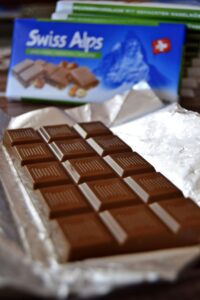
German sweet chocolate causes more confusion in the baking aisle than almost anything else. It sounds like it comes from Germany. It does not. The name comes from Samuel German, a baker who developed the formula in the mid-1800s for a well-known American chocolate company. It’s a mild, sweet dark chocolate with a lower cacao content than semisweet, sweeter, softer, and specifically suited to the cake that bears its name. German chocolate cake, with its coconut-pecan frosting, relies on that gentler chocolate profile. Substitute bittersweet and the whole balance shifts.
Milk chocolate has a place in baking too, though it’s a narrow one. Its higher milk-solid content and lower cacao percentage make it sensitive to heat; it scorches more easily and can turn grainy if not handled carefully. It shines in cookies where you want sweetness up front, in trail mix bark, in any application where you’re not asking it to melt smoothly into a batter. Don’t use it as a swap for semisweet in brownies unless you want something noticeably sweeter and less chocolatey in any serious sense.
White chocolate is not chocolate in the cacao-solid sense. It contains cocoa butter but no cocoa solids, which is why it lacks that characteristic chocolate flavor. In baking,g it behaves differently from all the others; it’s sweeter, richer, and prone to seizing if overheated. It works beautifully in blondies, in cream cheese frostings, in a blonde ganache drizzled over something tart. Real white chocolate lists cocoa butter as an ingredient; if the label says “confectionery coating” or “white baking chips” with no cocoa butter, you’re working with a vegetable-fat substitute that will melt more cleanly but taste thinner.
The Chip Problem

Chocolate chips are engineered to hold their shape. That’s their whole job. They’re formulated with stabilizers that allow them to sit in cookie dough, go through a hot oven, and emerge still looking like chips, glossy little mounds, not a puddle. In a cookie, that’s exactly what you want.
The same property makes them a poor choice for melting. If you’ve ever tried to make a ganache with chocolate chips and wound up with something grainy or reluctant to smooth out, this is why. For any recipe that asks you to melt chocolate, a sauce, a glaze, a mousse, a truffle, reach for a bar or a wafer instead. The bar will melt cleaner, combine more smoothly with cream or butter, and give you the texture the recipe is counting on.
Baking wafers, sometimes called pistoles or fèves, are discs of chocolate designed specifically for melting. They’re what professional pastry cooks and chocolatiers use because the smaller surface area melts faster and more evenly. Many grocery stores carry them now in the baking aisle, and they’re worth finding.
Cocoa Powder Is a Category of Its Own

Natural cocoa powder and Dutch-process cocoa powder look almost identical in the bag. They are not interchangeable in recipes that rely on leavening.
Natural cocoa is acidic. In a recipe with baking soda, the acid and base react to give the cake or cookie its rise. Dutch-process cocoa has been treated with an alkali to neutralize its acidity; it’s darker and mellower and will not trigger the same reaction with baking soda. Use Dutch-process in a recipe written for natural cocoa, and you may end up with something flat. The reverse can make a recipe taste sharp and metallic.
The fix is simple: use what the recipe specifies. If the recipe doesn’t specify, and it’s an older American recipe, one from a community cookbook, a church collection, a magazine feature from the 1970s, assume natural cocoa. Dutch-process became more widely available to home bakers gradually, and older recipes predate it.
A Few Things Worth Remembering

Quality does matter, and you don’t have to spend a great deal to find it. Mid-range brands at most grocery stores perform reliably. The moment you start tasting the chocolate before it goes into the bowl, really tasting it, the way you’d taste wine before cooking with it, you’ll develop instincts faster than any chart can give you.
Store chocolate wrapped and away from strong smells. It absorbs odors easily. And if your chocolate has developed a whitish bloom on the surface, that’s cocoa butter or sugar that’s migrated to the surface; it looks wrong, but the chocolate is still perfectly fine to bake with.
How strange it is to remember now that for most of American baking history, home cooks worked with a much shorter list of options than what fills the shelves today. Unsweetened chocolate, a can of cocoa, maybe a bag of chips. What they made with those few tools still holds up. The recipes didn’t need more variety. They needed cooks who paid attention.
The next time a recipe specifies bittersweet, it’s worth taking a moment to look at the cacao percentage on the label you’re holding. That small number is doing more work than it looks like.
Sources
Background on chocolate composition, cacao percentages, and classification
Overview of chocolate varieties including unsweetened, bittersweet, semisweet, and white chocolate
Explanation of Dutch-process vs. natural cocoa powder and their chemical differences
This article was created with AI assistance and reviewed for clarity and accuracy.